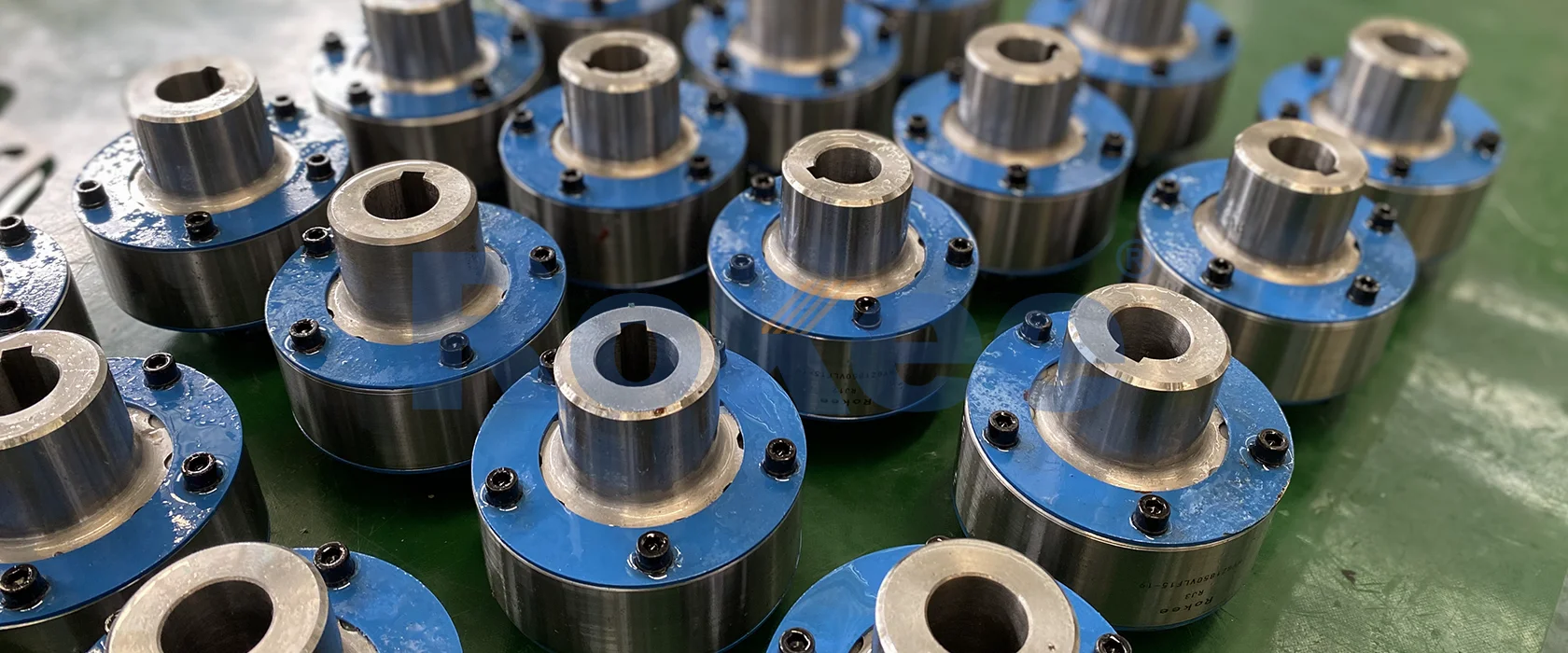
Rokee is a well-known high-quality supplier of Elastic Couplings and technical services in China, customize elastic couplings according to user drawings, alternatively, if the user provides elastic couplings parameters, we can select the model and design drawings for you, support wholesale and export.


Elastic coupling as a core component in mechanical transmission systems, is a mechanical device that can connect two shafts and allow for a certain relative displacement while transmitting motion and power. Compared with rigid couplings, elastic couplings can not only transmit torque through their unique elastic elements, but also effectively compensate for various alignment deviations between shaft systems, buffer vibration impacts, and improve the dynamic performance of the entire transmission system.
In modern industrial applications, elastic couplings have become the preferred solution for solving complex shaft connection problems. From precision instruments to heavy machinery, from low-speed high torque to high-speed rotating equipment, elastic couplings are widely used in various industrial fields such as wind power, metallurgy, shipbuilding, petrochemicals, machine tools, pumps, etc. due to their excellent performance.
The core function of an elastic coupling is based on its unique principle of elastic deformation. When power is transmitted from the driving shaft to the driven shaft, the elastic elements in the coupling undergo controllable elastic deformation, which can effectively absorb and alleviate the impact of various adverse factors on the transmission system.
Radial compensation: allows for a certain degree of parallel offset between the two axis lines
Angular compensation: allows for a certain degree of angular deviation between two axes
Axial compensation: allows for a certain displacement of the two axes along the axis direction
In addition, elastic couplings can absorb vibration energy through the damping characteristics of elastic elements, reduce the resonance peak of the system, and protect equipment from damage caused by impact loads. This design concept of "using softness to overcome rigidity" greatly improves the smoothness and reliability of the transmission system while maintaining efficient power transmission.
Bushed pin coupling
This is one of the most common types of elastic couplings, which uses rubber or polyurethane elastic sleeves as cushioning elements. Its structure is simple, cost-effective, and suitable for general industrial transmission applications. The hardness of the elastic sleeve can be adjusted according to the load requirements to achieve different elastic characteristics and torque transmission capabilities.
Plum coupling
Using star shaped plum blossom shaped elastomers as connectors, it has a large angular and radial compensation capability. This design makes the stress distribution of the coupling more uniform when subjected to misalignment, extending its service life. The plum blossom shaped coupling is particularly suitable for situations with significant installation errors or the possibility of foundation settlement.
Tire coupling
Composed of rubber tire like elastic elements and two half couplings, it has excellent shock absorption and noise reduction performance. Its unique structure can absorb displacement deviations in multiple directions, and is commonly used in applications such as ship propulsion systems and large wind turbines that require high shock absorption.
Diaphragm coupling
Using multi-layer metal film groups as elastic components, it has the characteristics of zero backlash and high stiffness. This type of coupling does not require lubrication, is easy to maintain, and is particularly suitable for high-speed transmission applications such as turbomachinery, centrifugal compressors, etc.
Serpentine spring coupling
Using a specially shaped snake shaped spring as an elastic element, it combines high elasticity and high strength. Its unique "spring pack" structure can effectively balance load distribution and is suitable for heavy-duty and impact load applications, such as steel mills, crushers, and other heavy equipment.
Rated torque: The maximum torque value that the coupling can continuously transmit is the primary basis for selection
Maximum torque: The instantaneous overload capacity that a coupling can withstand, typically 2-3 times the rated torque
Speed range: The safe operating speed range of the coupling, and special attention should be paid to high-speed applications
Compensation capability: including radial, angular, and axial displacement compensation amounts
Stiffness characteristics: torsional stiffness affects the dynamic response and resonance frequency of the system
Environmental adaptability: including special requirements such as temperature range, corrosion resistance, dust and water resistance
Service life: a durability index closely related to working conditions and load characteristics
Determine application requirements: Analyze basic information such as equipment type, power characteristics, and working environment
Calculate load parameters: accurately calculate normal operating torque, peak torque, and speed range
Evaluate alignment conditions: measure or estimate various alignment deviations that may exist in the shaft system
Consider environmental factors: assess the impact of temperature, humidity, corrosive media, and other environmental factors
Select appropriate type: Choose the most suitable coupling structure based on the above factors
Determine specific specifications: Refer to the performance curve and technical parameters provided by the manufacturer to determine the specifications
Verify installation space: Ensure that the coupling size matches the available installation space
In special application scenarios, such as high-precision CNC machine tools or aerospace equipment, more professional performance indicators such as transmission accuracy and dynamic response characteristics of couplings need to be considered.
Accurate alignment: Although elastic couplings have compensation capabilities, good initial alignment can significantly extend their service life
Avoid forced installation: It is not allowed to install the coupling by violent means such as hammering
Correct tightening: Tighten the connecting bolts according to the specified torque value, avoiding over tightening or over loosening
Protecting elastic components: preventing the elastic body from being cut or chemically corroded during installation
Regular inspection: Establish a regular inspection system to monitor the condition of the coupling
Observation of anomalies: Pay attention to abnormal phenomena such as vibration, noise, temperature, etc
Elastic replacement: timely replacement of aging and cracked elastic components
Lubrication management: Maintain appropriate lubrication status for the types of couplings that require lubrication
Record analysis: Establish maintenance records to document the operational status and replacement history of the coupling
Wind turbine generator: Large diaphragm coupling connects the gearbox and generator to compensate for deviations caused by tower deformation
Petrochemical industry: corrosion-resistant elastic couplings are used for pump and compressor transmission, adapting to harsh environments
Steel rolling mill: Heavy duty serpentine spring coupling withstands huge impact loads
Ship propulsion system: tire type coupling effectively isolates the vibration of the main engine and protects the propulsion shaft system
CNC machine tool: high-precision diaphragm coupling ensures transmission accuracy and dynamic response
Rail transit: Elastic couplings are used to connect traction motors and gearboxes, improving operational stability
As an indispensable key component in modern mechanical transmission, the technological progress of elastic couplings directly affects the performance and reliability of the entire mechanical system. With the continuous emergence of new materials and processes, elastic couplings will play a more important role in a wider range of fields.
In the vast landscape of mechanical power transmission systems, elastic couplings stand as indispensable components that bridge the gap between driving shafts and driven shafts, addressing a host of operational challenges that rigid couplings cannot resolve. Unlike rigid connection devices that demand perfect shaft alignment and offer no tolerance for mechanical stress or vibration, elastic couplings are engineered with flexible elements integrated into their core structure, enabling them to transmit torque reliably while compensating for shaft misalignment, absorbing shock loads, and dampening unwanted vibrations generated during machinery operation. This unique combination of torque transmission capability and adaptive flexibility has made elastic couplings a staple in nearly every industrial sector that relies on rotating machinery, from small-scale precision equipment to heavy-duty industrial production lines. The fundamental structure of a standard elastic coupling typically consists of two rigid hubs, which are securely mounted onto the driving and driven shafts respectively, and a central elastic component that connects the two hubs. The hubs are usually crafted from high-strength metals such as carbon steel, alloy steel, or aluminum alloy, chosen for their exceptional mechanical strength, wear resistance, and ability to withstand repeated torsional loads without deformation. The elastic element, the heart of the coupling, is made from materials with outstanding flexibility, resilience, and fatigue resistance, including natural rubber, synthetic rubber, polyurethane, and in some high-precision designs, thin metal sheets or machined metal beams with integrated flexible slots. Each material selection is tailored to specific operational conditions, such as temperature ranges, exposure to oil or chemicals, load intensity, and required flexibility levels, ensuring the coupling performs optimally in its intended environment.
The core performance attributes of elastic couplings define their suitability for diverse applications, and these traits are directly shaped by their structural design and material composition. One of the most critical performance features is misalignment compensation, which encompasses three primary forms: radial misalignment, angular misalignment, and axial misalignment. Radial misalignment refers to the parallel offset between the central axes of the two connected shafts, angular misalignment involves the intersection of the two shaft axes at a slight angle, and axial misalignment is the forward or backward movement of shafts along their central axis during operation. High-quality elastic couplings can accommodate moderate to substantial levels of all three misalignment types, reducing the extreme mechanical stress that would otherwise damage bearings, shafts, and connected equipment, and extending the service life of the entire transmission system. Another key performance metric is shock absorption and vibration damping capacity. In industrial machinery, sudden load changes, startup impacts, and operational vibrations are common, and these forces can cause premature wear, noise, and even catastrophic failure if left unmitigated. The elastic element in the coupling acts as a buffer, compressing and deforming under impact loads to absorb excess energy, then releasing that energy gradually to maintain smooth power transmission, effectively isolating vibrations between the driving and driven ends. Torsional flexibility and torsional stiffness are also balanced performance parameters; while the coupling needs sufficient flexibility to handle misalignment and shocks, it must also maintain adequate torsional stiffness to ensure efficient torque delivery without excessive windup or backlash, which is crucial for maintaining operational precision in equipment that requires consistent speed and torque output. Additionally, elastic couplings are valued for their ease of installation and maintenance, as most designs do not require lubrication, and worn elastic elements can often be replaced without disassembling the entire shaft system, minimizing downtime and operational disruption. Durability under harsh conditions, such as high or low temperatures, exposure to oil, moisture, or abrasive particles, is another vital performance aspect, with specialized material formulations enhancing resistance to these environmental stressors for long-term reliable performance.
Elastic couplings are categorized into several distinct types based on their structural design and the form of their elastic elements, each with unique performance characteristics that make them ideal for specific industrial scenarios. One of the most widely used classifications is the jaw-type elastic coupling, which features two hub components with interlocking claw-like protrusions and a central elastic spider insert positioned between the jaws. The elastic spider, typically made of oil-resistant rubber or polyurethane, is the flexible core that transmits torque and absorbs shocks. This design offers a compact structure, high torque transmission capacity, moderate misalignment compensation, and low backlash, making it suitable for medium-load applications where space is limited and consistent power delivery is essential. The jaw-type coupling is versatile, with variations in the hardness of the elastic spider allowing for adjustments in stiffness and damping to match different load requirements; softer spiders provide better vibration damping, while harder ones offer higher torsional stiffness for more precise operation. Another prominent type is the tire-type elastic coupling, which utilizes a flexible, reinforced rubber or polyurethane tire as the central connecting element between the two hubs. The tire element is designed with a curved, hollow structure that provides exceptional flexibility, enabling it to compensate for large degrees of radial, angular, and axial misalignment simultaneously. This type excels in heavy-load, high-vibration environments, offering superior shock absorption and noise reduction, and it is particularly effective in machinery that operates with frequent load fluctuations. However, the tire-type coupling generally has lower torsional stiffness compared to jaw-type designs, making it less suitable for high-precision applications that demand minimal rotational lag.
Beam-type elastic couplings represent a category of precision-focused designs, primarily used in small-scale, high-accuracy mechanical systems. These couplings are machined from a single piece of lightweight metal, such as aluminum alloy or stainless steel, with precision-cut spiral or parallel flexible slots along the body. The spiral beam design features a continuous, multi-turn slot that creates a long, flexible beam structure, offering excellent elasticity and minimal bearing load, making it ideal for compensating angular and axial misalignment in low-torque, high-precision equipment. Parallel beam designs, by contrast, have multiple short, parallel slots that overlap to enhance torsional stiffness while maintaining good misalignment compensation, suitable for applications that require both precision and moderate torque transmission, such as servo motor systems and encoder connections. Unlike elastomer-based couplings, beam-type elastic couplings have no separate elastic components, eliminating the risk of elastomer wear or degradation, and providing zero backlash for ultra-precise motion control. Membrane-type or disc-type elastic couplings are another high-performance category, constructed with multiple thin, flexible metal discs or membranes clamped between the hubs and intermediate flanges. The metal discs deform elastically under load to accommodate misalignment, offering high torsional stiffness, excellent fatigue resistance, and the ability to operate at high rotational speeds. This design is maintenance-free, highly durable, and resistant to extreme temperatures and chemical exposure, making it suitable for high-speed, high-torque applications in demanding industrial environments, where precision and reliability are non-negotiable. Additionally, there are pin-and-bush type elastic couplings, which feature rigid pins on one hub connected to the other hub via elastic bushings, typically made of rubber or nylon. This design provides robust torque transmission and effective shock absorption, with the elastic bushings handling misalignment and reducing impact forces, commonly used in heavy machinery and large-scale power transmission systems.
The diverse structural designs and performance profiles of elastic couplings translate to a wide range of industrial applications, with each type tailored to address the unique operational demands of different machinery and sectors. In the field of general industrial machinery, jaw-type elastic couplings are extensively used in pumps, fans, compressors, and gearboxes, where they deliver reliable torque transmission, moderate misalignment compensation, and effective vibration damping to ensure smooth and quiet operation. These couplings are well-suited for continuous running equipment in manufacturing plants, water treatment facilities, and HVAC systems, balancing performance and cost-effectiveness for long-term use. Tire-type elastic couplings find their primary applications in heavy-duty industrial equipment, including mining machinery, crushing equipment, conveyor systems, and large-scale mixing machines. The high misalignment tolerance and superior shock absorption of the tire element make it ideal for these harsh environments, where shafts are prone to significant misalignment due to heavy loads and machinery movement, and sudden impact loads are common. The ability of tire-type couplings to absorb these extreme forces protects the underlying shafts, bearings, and gear systems from damage, reducing maintenance frequency and extending equipment lifespan in rugged industrial settings.
Precision manufacturing and automation sectors rely heavily on beam-type and miniature elastic couplings, which are essential for servo motors, stepper motors, ball screw drives, encoders, and linear motion systems. In CNC machine tools, robotic arms, and precision testing equipment, these couplings provide zero backlash, high torsional stiffness, and precise motion transmission, ensuring the accuracy of positioning and movement control critical for high-precision manufacturing processes. The lightweight, compact design of beam couplings also minimizes inertia, allowing for rapid acceleration and deceleration without compromising precision, making them indispensable in modern automated production lines and high-tech manufacturing equipment. Membrane-type and disc-type elastic couplings are the preferred choice for high-speed and high-performance applications, such as turbomachinery, generators, high-speed pumps, and aerospace ground support equipment. Their metal-based flexible design enables operation at extremely high rotational speeds while maintaining exceptional torsional stability, and their resistance to extreme temperatures, oil, and chemicals makes them suitable for specialized industrial environments where elastomer-based couplings would degrade rapidly. These couplings offer long service life with zero maintenance, a critical advantage in applications where downtime is costly and equipment accessibility is limited.
Beyond these core sectors, elastic couplings play a vital role in transportation, marine engineering, renewable energy systems, and food and beverage processing. In automotive and marine applications, elastic couplings are used in engine and transmission systems to dampen engine vibrations and compensate for shaft misalignment caused by vehicle or vessel movement, enhancing driving and sailing comfort while protecting powertrain components. In wind turbine and solar tracking systems, they accommodate shaft misalignment caused by structural movement and variable wind loads, ensuring reliable power transmission from the turbine rotor to the generator. In food and beverage processing machinery, where hygiene and clean operation are paramount, stainless steel and food-grade elastomer elastic couplings are used to meet strict sanitary standards, providing corrosion resistance and easy cleaning while maintaining reliable performance. The adaptability of elastic couplings to different operational conditions—whether low-torque precision, high-torque heavy load, high-speed rotation, or harsh environmental exposure—underscores their universal importance in mechanical engineering. As industrial technology continues to advance, the design and material innovation of elastic couplings will further expand their capabilities, with a focus on higher durability, enhanced precision, and greater adaptability to emerging industrial needs, solidifying their role as a foundational component in efficient, reliable, and long-lasting mechanical power transmission systems across the globe.
When selecting the appropriate elastic coupling for a specific application, engineers must evaluate a comprehensive set of factors to ensure optimal performance and compatibility, including torque requirements, rotational speed, type and degree of shaft misalignment, environmental conditions, installation space constraints, and operational lifespan expectations. Matching the coupling’s structural type and material to these factors is crucial; for example, a high-precision servo system requires a zero-backlash beam coupling, while a heavy-duty conveyor system demands a high-load tire-type or pin-and-bush coupling. Proper installation and alignment, even with elastic couplings, also play a key role in maximizing performance, as excessive misalignment beyond the coupling’s design capacity can lead to premature wear and failure. Regular inspection of the elastic element for signs of wear, cracking, or degradation is recommended for elastomer-based couplings, allowing for timely replacement and preventing unexpected equipment downtime. In contrast, metal-based elastic couplings like beam and disc types require minimal inspection due to their one-piece or metal disc construction, offering a maintenance-free solution for critical applications. Overall, the versatility, performance diversity, and practical utility of elastic couplings make them an irreplaceable part of modern mechanical engineering, enabling the smooth and efficient operation of countless pieces of machinery that drive industrial production, technological innovation, and daily infrastructure functionality.
pu sandwich panel line,pu sandwich panel machine,sandwich panel machine
« Elastic Couplings » Latest Update Date: 2026/3/24 , https://www.rokeecoupling.net/tags/elastic-couplings.html