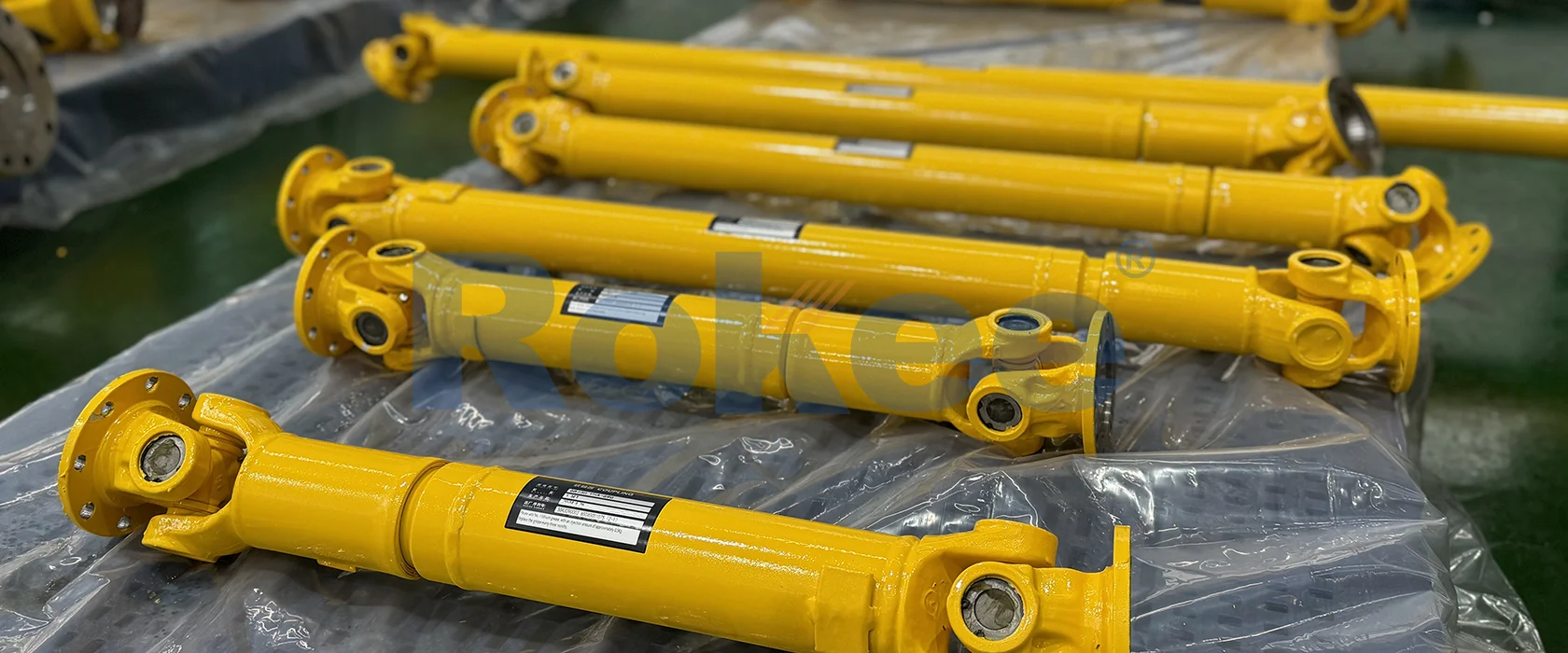
Rokee is a well-known high-quality supplier of Cardan Drive Shafts and technical services in China, customize cardan drive shafts according to user drawings, alternatively, if the user provides cardan drive shafts parameters, we can select the model and design drawings for you, support wholesale and export.


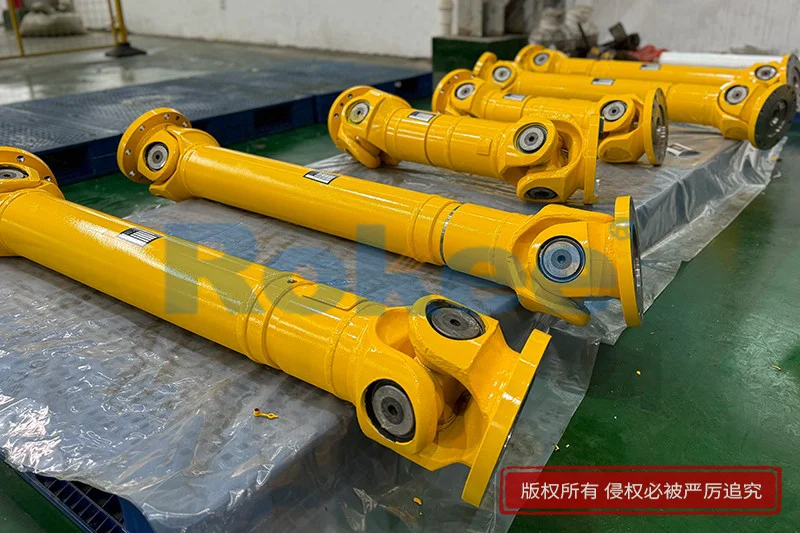
Cardan Drive Shaft is a mechanical connection device that allows for angular deviation between two shafts, capable of transmitting rotational motion and torque between two non coaxial shafts. Its core function is to solve the connection problem caused by misalignment of the axis during power transmission.
The working principle is based on the cross axis structure: when the driving shaft rotates, the rotational motion is transmitted to the driven shaft through the linkage of the cross axis. Even if there is a certain angular deviation between the two shafts (usually up to 45 degrees), continuous torque transmission can be maintained. This design enables the transmission system to adapt to various complex installation conditions and motion states.
Cross axis Cardan Drive Shaft
The most common type consists of two Y-shaped forks and a cross axis
Simple structure, strong load-bearing capacity, and low cost
Allow a working angle of 15 ° -45 °
Widely used in automotive transmission systems
Double Cardan Drive Shaft
Connected by a spline shaft between two cross axis Cardan Drive Shafts
Can compensate for greater angular deviation and axial displacement
Used for long-distance transmission or situations with significant installation errors
Cage type constant velocity Cardan Drive Shaft
Adopting a spherical raceway and cage structure
Realize true constant speed transmission without speed fluctuations
The maximum working angle can reach 50 °
Standard configuration of modern front wheel drive vehicles
Trident constant velocity Cardan Drive Shaft
Structure between cross axis and cage type
Low cost but performance close to cage style
Commonly seen in some economy sedans
Rated torque: the maximum torque value that the transmission shaft can continuously transmit
Maximum speed: the highest rotational speed that ensures safe operation
Working angle: maximum allowable deflection angle between two axes
Torsional stiffness: the ability to resist torsional deformation
Dynamic balance level: vibration control standard during high-speed rotation
Lubrication method: grease lubrication or oil lubrication and their maintenance cycle
Automotive industry
The transmission shaft system of traditional rear wheel drive vehicles
The transfer case and front/rear axle connection of four-wheel drive vehicles
Steering column connection in steering system
Construction Machinery
Power transmission of excavators and loaders
PTO (power output shaft) connection of agricultural machinery
Industrial equipment
The transmission system of machine tools
Power transmission device on the production line
Ship propulsion system
Common fault phenomena:
Abnormal vibration: usually caused by wear, imbalance, or excessive angle
Abnormal noise: a manifestation of insufficient lubrication or damage to internal components
Oil leakage: seal aging and failure
Excessive clearance: wear of the cross shaft or bearing
Maintenance points:
Regularly check the lubrication condition and replenish special lubricating grease according to the instructions
Maintain the working angle within the design range and avoid extreme deflection
Regularly check the status of fasteners to prevent looseness
Pay attention to dust and water prevention, and avoid impurities from entering the bearing area
High speed applications require special attention to the dynamic balance state
Replacement standard:
Radial clearance exceeding 0.5mm
The cross axis shows obvious wear grooves
The bearing needle roller is broken or missing
Cracks or deformations appear on the outer shell
As a classic invention in the field of mechanical transmission, Cardan Drive Shafts have maintained strong vitality after more than a hundred years of development. From simple agricultural machinery to precision aerospace equipment, this technology continues to evolve and provide reliable solutions for various rotary power transmission needs. Understanding its principles and characteristics is of great significance for mechanical design, maintenance, and fault diagnosis.
The Cardan drive shaft, a fundamental and versatile mechanical transmission component, plays an irreplaceable role in modern mechanical systems by enabling the efficient transfer of torque and rotational motion between two shafts that are not collinear, have angular misalignment, or experience relative displacement during operation. Unlike rigid shaft connections that require perfect axial alignment, the Cardan drive shaft is engineered to accommodate dynamic changes in shaft position, making it a cornerstone of nearly all mobile and fixed mechanical equipment that demands flexible power transmission.
At its core, the standard Cardan drive shaft features a modular, articulated structure that balances strength, flexibility, and rotational efficiency. The most common configuration consists of three primary interconnected parts: a central shaft tube, two universal joints (often referred to as U-joints) positioned at either end of the tube, and in many designs, a slip spline assembly that allows for axial length adjustment. The universal joint is the heart of the entire system, typically constructed with two fork-shaped yokes, a cross-shaped trunnion (commonly called a cross shaft or spider), and a set of precision bearings that enable smooth articulation between the yokes and the cross shaft. These bearings are usually needle roller bearings, chosen for their high load-bearing capacity, compact size, and ability to handle both radial and thrust forces generated during rotation; in some heavy-duty variants, plain sliding bearings may be used to withstand extreme loads and harsh operating conditions. The central shaft tube is not a solid rod in most standard designs, but a hollow, precision-machined cylinder made from high-strength alloy steel, which optimizes the strength-to-weight ratio, reduces rotational inertia, and minimizes vibration during high-speed operation. Solid shaft versions are reserved for ultra-heavy-duty applications where maximum torsional rigidity is non-negotiable, even with the trade-off of increased weight. The slip spline assembly, integrated into one end of the central tube or between the tube and a universal joint, consists of internal and external splined shafts that slide longitudinally while maintaining a rigid torque connection, compensating for changes in the distance between the driving and driven components as equipment moves or operates. This axial compensation is critical for preventing mechanical stress, binding, or premature failure in systems where shaft separation varies, such as vehicle suspension systems or industrial machinery with moving components.
Beyond the basic structure, advanced Cardan drive shaft designs incorporate additional engineering features to enhance performance and durability. Many heavy-duty and high-speed models include balancing weights precision-welded to the shaft tube to counteract rotational imbalance, which is vital for reducing vibration, noise, and wear on connected bearings and components at elevated RPM. Some units feature protective boots or sealing caps around the universal joint bearings to retain lubrication and prevent contamination from dust, moisture, debris, or corrosive substances, extending the service life of the joint in harsh outdoor or industrial environments. For applications requiring greater angular deflection, double Cardan joint assemblies are used, which pair two universal joints with a short intermediate shaft to eliminate the non-uniform rotational speed that can occur with a single universal joint at larger angles. This design ensures constant velocity transmission across a wider range of angles, smoothing power delivery and reducing mechanical stress on the entire drive system. The materials used in Cardan drive shaft construction are carefully selected to match performance requirements: high-strength carbon steel is standard for general-purpose applications, while alloy steels with specialized heat treatment are used for heavy-duty and high-torque models to boost tensile strength, fatigue resistance, and toughness. The cross shafts and yokes undergo precision forging and heat treatment processes to enhance their load-bearing capacity and resistance to impact and torsional stress, ensuring consistent performance under cyclic loading conditions that are common in dynamic mechanical systems.
The performance of a Cardan drive shaft is defined by several key metrics that determine its suitability for specific applications, with torsional load capacity, angular misalignment tolerance, axial compensation range, rotational speed limit, and fatigue resistance being the most critical. Torsional load capacity refers to the maximum torque the shaft can transmit continuously without permanent deformation or failure, a parameter directly influenced by the diameter and material of the central shaft, the size and design of the universal joints, and the quality of the bearing and spline components. Heavy-duty Cardan shafts are engineered to handle extremely high torque loads, making them suitable for large industrial machinery, while light-duty variants are optimized for lower torque levels in smaller equipment and vehicles. Angular misalignment tolerance is another defining performance trait; standard single universal joints can typically accommodate angular offsets between the driving and driven shafts ranging from a few degrees up to approximately 45 degrees, depending on the design, while double joint assemblies maintain smooth operation at even larger angles by canceling out speed fluctuations. This flexibility allows the shaft to adapt to manufacturing tolerances during assembly, structural movement during operation, and dynamic shifts in component position, eliminating the need for perfect alignment that is impractical in most real-world mechanical systems.
Axial compensation capability, enabled by the slip spline assembly, allows the Cardan shaft to adjust its overall length within a specified range, typically several inches to a foot or more, depending on the application. This feature is essential for systems where the distance between the power source and the driven component changes, such as in vehicles with independent suspension, where the rear axle moves up and down relative to the transmission, or in industrial machinery with sliding or telescoping components. Rotational speed performance is equally important, as high-speed applications require shafts with minimal imbalance, low rotational inertia, and precision-balanced components to avoid resonant vibration, which can cause component failure, excessive noise, and reduced operational efficiency. Shafts designed for high-speed use often feature thinner walled hollow tubes, precision balancing, and sealed, low-friction bearings to maintain smooth operation at thousands of RPM. Fatigue resistance is a long-term performance metric that reflects the shaft’s ability to withstand repeated cyclic loading and torsional stress without developing cracks or structural failure over time. This is heavily dependent on material quality, heat treatment, manufacturing precision, and proper lubrication, as fatigue failure is a common issue in drive shafts subjected to constant start-stop cycles, variable loads, and dynamic misalignment. Additionally, Cardan drive shafts offer high mechanical efficiency, with minimal power loss through the universal joints and splines, ensuring that nearly all the input torque is transferred to the driven component, making them highly energy-efficient compared to other flexible transmission methods.
Cardan drive shafts are classified into distinct categories based on structural design, load capacity, operational speed, application-specific features, and angular compensation capabilities, with each category tailored to meet the unique demands of different mechanical systems. The most basic classification is based on the number of universal joints: single joint Cardan shafts, which consist of a central tube with one universal joint at each end, and double joint Cardan shafts, which feature two pairs of universal joints connected by a short intermediate shaft. Single joint shafts are suitable for applications with small to moderate angular misalignment and lower rotational speeds, where minor speed fluctuations are acceptable, while double joint shafts are preferred for high-speed, high-precision applications, or those requiring large angular deflection, as they deliver constant velocity rotation and smoother power transfer. Another major classification is based on load capacity, dividing shafts into light-duty, medium-duty, and heavy-duty variants. Light-duty Cardan shafts are compact, lightweight, and designed for low-torque, high-speed applications such as small passenger vehicles, light industrial equipment, agricultural machinery, and small pumps or compressors. They feature smaller diameter shaft tubes, smaller universal joints, and standard carbon steel construction, optimized for space efficiency and low inertia. Medium-duty shafts strike a balance between load capacity and weight, suitable for a wide range of general industrial applications, commercial vehicles, and medium-sized construction equipment, handling moderate torque loads and moderate operating speeds with durable alloy steel components. Heavy-duty Cardan shafts are robust, oversized units built for extreme torque, heavy impact loads, and harsh operating conditions, featuring thick-walled solid or hollow shafts, large reinforced universal joints, heavy-duty bearings, and high-strength alloy steel with specialized heat treatment. These shafts are engineered to withstand continuous heavy use in large industrial machinery, mining equipment, construction cranes, and heavy commercial vehicles, where failure would result in significant operational downtime.
Cardan shafts can also be classified by the presence or absence of axial compensation: fixed-length shafts and telescopic (slip) shafts. Fixed-length Cardan shafts have no spline assembly and a set overall length, designed for applications where the distance between the driving and driven shafts remains constant, and only angular misalignment needs to be accommodated. These are simpler in design, more rigid, and suitable for fixed industrial machinery with stable shaft positioning. Telescopic slip shafts, equipped with a spline assembly, offer adjustable length and are the most common type, used in nearly all mobile equipment and dynamic mechanical systems where axial movement occurs. Additionally, shafts are categorized by operational speed: low-speed, high-torque shafts for heavy industrial machinery, and high-speed, low-inertia shafts for automotive, aerospace, and precision industrial applications. High-speed shafts undergo strict precision balancing and feature advanced bearing and sealing systems to maintain stability at elevated RPM, while low-speed shafts prioritize maximum torque capacity and impact resistance over rotational smoothness. Specialized Cardan shaft variants include those with corrosion-resistant coatings for marine, chemical, or outdoor applications, waterproof sealed joints for underwater or wet environments, and compact short-length shafts for equipment with limited installation space. Each classification is engineered to address specific operational challenges, ensuring that there is a Cardan shaft design suitable for nearly every flexible power transmission requirement.
The versatility of Cardan drive shafts is reflected in their extensive range of applications across nearly every sector of industry, transportation, and machinery, from small consumer-focused equipment to massive industrial manufacturing systems. In the automotive and transportation sector, Cardan drive shafts are integral components of most wheeled vehicles, including passenger cars, commercial trucks, buses, off-road vehicles, and agricultural tractors. In these applications, they transmit power from the transmission or transfer case to the drive axles, accommodating the vertical movement of the suspension and the angular misalignment between the powertrain and the axles. Rear-wheel-drive and four-wheel-drive vehicles rely heavily on these shafts to deliver torque to the wheels while allowing for smooth suspension travel, ensuring stable handling and reliable power delivery on both paved roads and rough terrain. In agricultural machinery, such as tractors, harvesters, and tillers, Cardan shafts connect the power take-off (PTO) to attached implements, enabling the transfer of power to farming tools while adapting to the movement and height adjustments of the equipment. The ability to handle both angular and axial misalignment makes them ideal for the uneven terrain and dynamic operation of agricultural work.
In the industrial machinery sector, Cardan drive shafts are used in a vast array of fixed and mobile equipment, including manufacturing machinery, metalworking equipment, rolling mills, crushers, conveyors, pumps, fans, and compressors. In metal processing and rolling mills, they transmit high torque between motors and rolling mechanisms, accommodating the thermal expansion and mechanical movement of the equipment during operation, while withstanding the heavy loads and vibration inherent in metal forming processes. In mining and quarrying equipment, such as crushers, screens, and conveyor systems, heavy-duty Cardan shafts provide reliable power transmission in extremely harsh conditions, including dust, debris, and constant heavy loading, where durability and load capacity are paramount. In material handling systems, including conveyor belts and lifting equipment, they enable flexible power transfer between motors and drive mechanisms, adapting to misalignment caused by structural movement or assembly tolerances. They are also widely used in packaging machinery, textile machinery, and printing equipment, where precise, flexible power transmission is required for high-speed, continuous operation.
The construction and heavy machinery industry is another major application area for Cardan drive shafts, with use in excavators, loaders, bulldozers, cranes, pavers, and other construction equipment. These shafts connect the engine and hydraulic systems to the drive tracks, wheels, and working components, accommodating the extreme angular movement and heavy loads associated with construction work. The robust design of heavy-duty Cardan shafts ensures reliable performance in rugged outdoor environments, with the ability to withstand impact loads, vibration, and exposure to dirt, mud, and moisture. In marine and offshore applications, specialized corrosion-resistant Cardan shafts are used in boat propulsion systems, marine pumps, and deck machinery, transmitting power between engines and propellers or other marine components while resisting saltwater corrosion and accommodating the movement of the vessel’s hull. They are also used in small watercraft and industrial marine equipment, providing a flexible, durable power transmission solution that adapts to the dynamic conditions of marine operation.
Beyond these core sectors, Cardan drive shafts find use in aerospace and aviation equipment, where lightweight, high-strength variants transmit power in aircraft systems, helicopter rotor drives, and ground support equipment, prioritizing weight reduction and reliability. They are also used in recreational and entertainment equipment, such as amusement park rides, where they provide safe, flexible power transmission for moving components, and in material processing equipment, including woodworking machinery, food processing equipment, and chemical processing machinery. In all these applications, the key advantage of the Cardan drive shaft remains consistent: its ability to transmit torque efficiently while accommodating angular, axial, and radial misalignment, eliminating the need for perfect shaft alignment and reducing the wear and tear on connected components. This flexibility not only improves the reliability and lifespan of mechanical systems but also simplifies assembly and maintenance, as it compensates for manufacturing tolerances and operational wear that would otherwise cause premature failure.
In summary, the Cardan drive shaft is a masterclass in mechanical engineering, combining a simple yet effective articulated structure with high-performance materials and precision manufacturing to deliver flexible, reliable torque transmission across countless applications. Its core structural components—universal joints, central shaft tube, and slip spline assembly—work in harmony to accommodate dynamic shaft misalignment, while its key performance traits, including high torque capacity, angular flexibility, fatigue resistance, and mechanical efficiency, make it indispensable in modern mechanical systems. The diverse classifications of Cardan shafts, tailored to load capacity, speed, structure, and application, ensure that a suitable design exists for every operational requirement, from light-duty high-speed automotive use to heavy-duty industrial mining and construction applications. As mechanical systems continue to evolve toward greater efficiency, durability, and flexibility, the Cardan drive shaft will remain a vital component, adapting to new technological demands while retaining its core functionality as a cornerstone of power transmission. Its widespread use across nearly every industry underscores its timeless design and unparalleled versatility, making it one of the most important and widely used mechanical components in modern engineering.
pu sandwich panel line,pu sandwich panel machine,sandwich panel machine
« Cardan Drive Shafts » Latest Update Date: 2026/3/24 , https://www.rokeecoupling.net/tags/cardan-drive-shafts.html