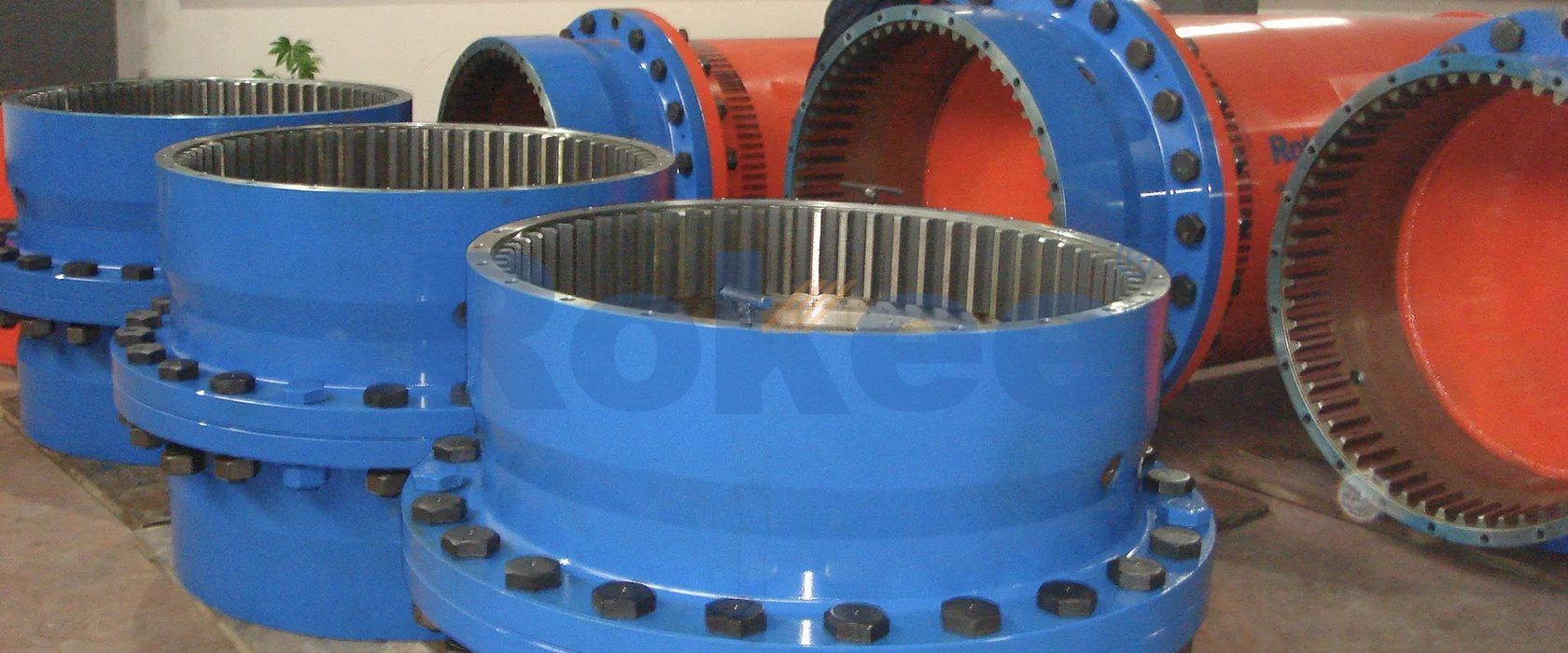
Rokee is a well-known high-quality supplier of Brake Drum Gear Couplings and technical services in China, customize brake drum gear couplings according to user drawings, alternatively, if the user provides brake drum gear couplings parameters, we can select the model and design drawings for you, support wholesale and export.


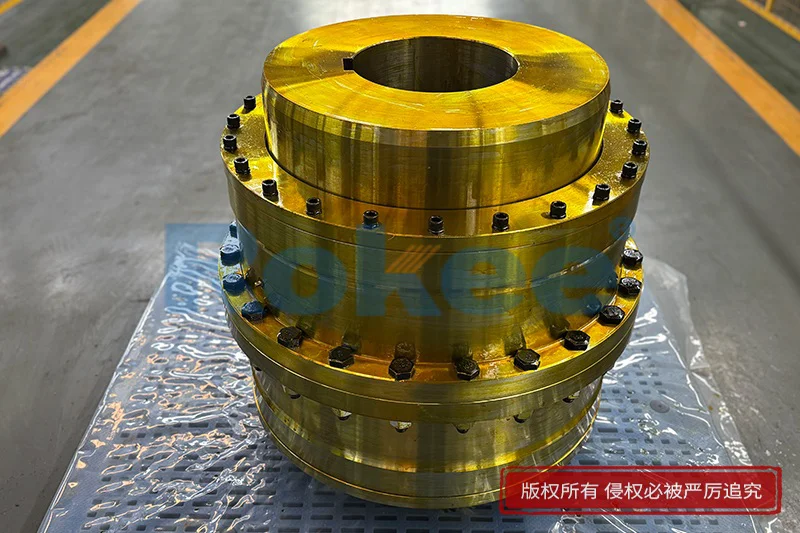
The brake drum gear coupling is an advanced mechanical transmission device that integrates braking function. It combines traditional drum gear couplings with braking systems and demonstrates unique advantages in the field of transmission. This type of coupling not only has excellent torque transmission capability and angle compensation performance, but also can achieve rapid braking when needed, and is widely used in various heavy machinery and precision equipment that require precise braking. In modern industrial transmission systems, brake drum gear couplings have become the preferred transmission components in fields such as metallurgical equipment, mining machinery, lifting equipment, and ship propulsion systems. Its outstanding performance meets the strict requirements of high torque transmission, reliable braking, and long lifespan in these application scenarios.
Drum gear coupling body: including inner gear ring and outer gear sleeve, adopting a special drum shaped gear design, and the gear surface is precision machined and hardened
Brake drum component: usually made of cast iron or steel cylinder, designed as an integral part of the coupling, with a special surface treatment to improve the friction coefficient
Braking mechanism: including brake shoes, brake pads, brake springs, and brake cylinders/hydraulic cylinders and other components
Sealing system: It is crucial to prevent lubricant leakage and external contaminants from entering, especially under harsh working conditions
In the transmission state, the torque of the electric motor or engine is transmitted to the driven shaft through the meshing of the coupling teeth. The special design of drum shaped teeth allows for a certain range of axial, radial, and angular offsets, effectively compensating for installation errors and displacement during operation.
When braking is required, the control system triggers the action of the braking mechanism, and the brake shoe presses against the inner surface of the brake drum under the action of the cylinder or spring, achieving rapid braking through friction torque. Advanced brake drum gear couplings are usually equipped with automatic brake clearance adjustment devices to ensure the stability of braking performance.
Transmission performance characteristics
High torque transmission capacity: Optimized tooth design and material selection increase torque transmission capacity by 30-50% compared to ordinary couplings
Excellent compensation capability: The drum tooth design allows for angular deviation of ± 1 °~± 1.5 ° and radial deviation of 0.5-3mm (depending on specifications)
Smooth transmission: The involute profile ensures smooth transmission, reduces vibration and noise
Braking performance advantages
Quick response: The braking action time can be controlled within 0.1-0.3 seconds to meet emergency braking needs
High braking torque: The combination of special friction materials can achieve a braking torque of 150-200% of the rated torque
Wear resistant and durable: The brake pads are made of composite materials, with a service life of millions of braking cycles
Comprehensive technological advantages
Compact integrated design: saves installation space, simplifies system structure
Maintenance free or low maintenance: Most adopt a lifetime lubrication design, with automatic compensation for brake component wear
High reliability: Dual protection design, even if the braking system fails, the coupling can still maintain its transmission function
Load characteristics: Consider peak torque, continuous working torque, and possible impact loads
Speed range: Ensure that the coupling does not resonate at the highest speed
Installation conditions: Evaluate shaft alignment and allowable deviation range
Braking requirements: Determine the necessary braking torque and response speed according to safety standards
Environmental factors: Consider the impact of temperature, humidity, dust, etc. on braking performance
Maintenance conditions: Select the appropriate coupling type for the maintenance cycle
Heavy industry sector
In the metallurgical industry, brake drum shaped gear couplings are widely used in equipment such as rolling mills and straightening machines. Their excellent braking performance ensures rapid shutdown in emergency situations and protects valuable equipment. After adopting this type of coupling in a large hot rolling plant, the equipment failure rate decreased by 40% and the maintenance interval was extended by three times.
Lifting and transportation machinery
Port cranes, bridge cranes and other equipment have extremely high requirements for braking performance. The application of brake drum shaped gear coupling in lifting mechanism solves the problems of brake vibration and rapid wear of brake lining in traditional braking systems. Actual application data shows that the braking stability has been improved by 60%, and the lining life has been extended by 2-3 times.
Ship propulsion system
The ship propulsion system requires the transmission device to have good compensation capability and reliable braking function. The gear coupling with integrated brake drum performs well in marine applications, especially maintaining stable performance in harsh sea conditions. After adopting a certain type of ocean going cargo ship, the shaft vibration was reduced by 35% and the emergency braking distance was shortened by 28%.
Other special applications
Mining machinery: elevators, crushers, etc
Wind power equipment: yaw braking system
Special vehicles: Heavy engineering machinery transmission system
Installation specifications
Alignment adjustment: use the laser alignment instrument to ensure that the shaft alignment is within the allowable range. Even if the drum gear coupling has the compensation ability, good alignment can still extend the service life
Bolt tightening: Cross tighten in steps according to the torque values provided by the manufacturer, using a torque wrench to ensure accuracy
Lubrication inspection: Confirm that the type and amount of lubricant added meet the requirements
Brake system debugging: adjust brake clearance, test brake response time and braking torque
maintenance
Regular inspection: Check the wear of the tooth surface and the thickness of the brake lining every 3-6 months
Lubrication management: Replace or supplement lubricants according to recommended cycles, using designated grades
Braking performance monitoring: Regular testing of braking response time and braking distance
Wear and tear parts replacement: When the remaining thickness of the brake lining is less than 2mm, it should be replaced in a timely manner
With the advancement of industry and the development of high-end equipment manufacturing, brake drum gear couplings will continue to develop towards high performance, intelligence, and environmental protection, providing more reliable solutions for various mechanical transmission systems.
In the field of industrial mechanical transmission, the brake drum gear coupling stands as a highly integrated and versatile component that combines the core functions of torque transmission and mechanical braking, filling the gap between standard gear couplings and independent braking systems in many heavy-duty and precision-driven equipment. Unlike conventional couplings that only focus on connecting drive shafts and compensating for axial, radial and angular misalignments, this specialized coupling integrates a rigid brake drum structure into the gear coupling framework, enabling synchronous operation of power transmission and emergency or routine braking without requiring separate installation of braking components. This dual-function design not only optimizes the spatial layout of mechanical transmission systems but also enhances operational stability and safety, making it an indispensable part in various industrial sectors that demand reliable power transfer and precise braking control. To fully understand its value and application scope, it is essential to delve into its detailed structural composition, inherent performance characteristics, diverse classification standards, and wide-ranging industrial uses, as each aspect directly determines its adaptability to different working conditions and operational efficiency.
At its core, the brake drum gear coupling inherits the basic structural framework of the traditional drum gear coupling while adding a dedicated brake drum assembly, with all components engineered to work in seamless coordination to withstand heavy loads and maintain consistent performance. The primary structural components include two flange half-couplings with external gear teeth, an inner gear sleeve that meshes with the external gear teeth, a tightly integrated brake drum, fastening connectors, and sealing components. The external gear teeth on the half-couplings are processed with a specific drum-shaped profile, which is a critical design feature that distinguishes gear couplings from other rigid or flexible couplings; this curved tooth shape allows for a certain degree of angular, radial and axial displacement compensation between the connected drive shafts, reducing the impact of shaft misalignment on transmission efficiency and component wear. The inner gear sleeve features matching internal gear teeth that wrap around the external gear teeth, forming a closed meshing space that ensures full contact between gear surfaces during torque transmission, distributing load evenly across all meshing teeth to avoid concentrated stress and extend service life. The brake drum, which is the defining component of this coupling type, is rigidly connected to one of the half-couplings or the inner gear sleeve, either through integral forging and casting or high-strength bolt fastening, ensuring no relative movement between the brake drum and the coupling body during high-speed rotation or sudden braking. This rigid connection is vital to guarantee that braking force can be quickly and efficiently transferred to the entire transmission system without delay or energy loss.
The structural design of the brake drum is equally meticulous, typically featuring a smooth, cylindrical outer surface with precise dimensional tolerances to ensure optimal friction contact with brake shoes or other braking mechanisms. The wall thickness of the brake drum is carefully calculated based on the required torque capacity and braking force, balancing structural strength and rotational inertia; a thicker wall provides higher rigidity and heat dissipation performance to resist thermal deformation during frequent braking, while avoiding excessive weight that would increase the load on the drive shafts and reduce transmission efficiency. Sealing components are installed at both ends of the inner gear sleeve to prevent the entry of dust, moisture, abrasive particles and other contaminants from the external environment, while retaining the lubricating grease inside the gear meshing area. Adequate lubrication is crucial for reducing friction and wear between the gear teeth, minimizing heat generation during high-speed operation, and preventing rust and corrosion in harsh working conditions. The overall structure is compact and modular, with no redundant parts, allowing for easy installation, disassembly and routine maintenance without extensive modifications to the existing transmission system. This robust and well-engineered structure lays a solid foundation for the coupling’s outstanding mechanical performance, enabling it to operate reliably in extreme working conditions such as heavy loads, low speeds, frequent starts and stops, and repeated braking.
In terms of performance, the brake drum gear coupling exhibits a unique combination of advantages that set it apart from standard gear couplings and other braking-integrated transmission components, covering torque transmission capacity, misalignment compensation, braking stability, durability and environmental adaptability. First and foremost, it boasts exceptional torque transmission capability, thanks to the multi-tooth meshing structure of the drum gear design. Compared with single-tooth or rigid couplings, the load is distributed across multiple gear teeth simultaneously, allowing it to transmit extremely high nominal torque and withstand peak impact loads that often occur in heavy machinery during startup or load changes. This high torque density means the coupling can handle heavy-duty transmission tasks with a relatively compact size, making it ideal for equipment with limited installation space. Secondly, its misalignment compensation performance is superior to rigid couplings, as the drum-shaped external gear teeth allow for a specific range of angular displacement (usually up to several degrees), radial displacement and axial displacement between the driving and driven shafts. This flexibility effectively absorbs vibration and shock generated during operation, reduces noise levels, and protects the connected motors, gearboxes, bearings and other precision components from premature damage caused by misalignment and impact forces.
Braking performance is the most prominent feature of this coupling, and it excels in providing stable, efficient and controllable braking force. The integrated brake drum eliminates the need for a separate braking disc or wheel, reducing the number of components in the transmission system and lowering the risk of mechanical failure associated with additional parts. When the braking mechanism applies pressure to the outer surface of the brake drum, the friction force generated is directly transferred to the drive shafts through the rigidly connected coupling body, achieving rapid deceleration or complete stop of the equipment without shutting down the power source. This feature is particularly critical in applications where emergency braking is required to prevent accidents or protect production materials, as it ensures instantaneous response and consistent braking effect every time. Additionally, the coupling offers excellent durability and low maintenance requirements. The use of high-strength alloy steel or high-grade cast iron for key components ensures resistance to wear, fatigue and thermal deformation; the drum gear teeth are precision machined and heat-treated to enhance surface hardness and wear resistance, while the sealed lubrication system minimizes the need for frequent re-lubrication. It can adapt to a wide range of environmental conditions, including dusty industrial sites, humid environments, and moderate temperature fluctuations, without significant degradation in performance. Unlike flexible couplings with elastic components that are prone to aging and damage, the all-metal structure of most brake drum gear couplings ensures a long service life with minimal maintenance, reducing downtime and operational costs for industrial equipment.
The classification of brake drum gear couplings is primarily based on structural design, installation method, braking mode and displacement compensation capacity, with each type tailored to meet specific operational requirements and equipment configurations. One of the most common classification criteria is the braking mechanism compatibility, which divides the couplings into two main categories: those designed for brake shoe braking systems and those optimized for disc braking systems. The first type features a standard cylindrical brake drum with a larger outer diameter, specifically engineered to match traditional brake shoe assemblies, where the brake shoes press against the inner or outer surface of the drum to generate friction; this type is widely used in heavy-duty, low-speed equipment that requires strong braking force and stable braking performance. The second type integrates a flanged brake disc structure with the gear coupling, suitable for compact disc brake systems that demand faster braking response and higher precision, commonly found in medium-speed and precision transmission equipment. Another key classification is based on the overall structural layout, including integral type and split type brake drum gear couplings. Integral type couplings have the brake drum and one half-coupling manufactured as a single piece through forging or casting, offering maximum rigidity and concentricity, ideal for high-load and high-precision applications where zero radial runout is critical. Split type couplings feature a detachable brake drum that can be assembled or replaced independently, simplifying maintenance and component replacement, making them suitable for equipment with limited access to the transmission system or frequent braking component wear.
Couplings can also be classified by the presence of an intermediate shaft, dividing them into short direct-connected types and long-distance transmission types with intermediate shafts. Short direct-connected brake drum gear couplings are designed for close-range shaft connection, with a compact axial size, suitable for equipment where the driving and driven shafts are positioned close to each other, such as motor and gearbox direct connections. Long-distance transmission types incorporate an intermediate shaft between the two half-couplings, allowing for torque transmission over a longer distance while maintaining the braking function and misalignment compensation performance; this type is used in large-scale machinery where the power source and working components are separated by a significant distance. Additionally, classifications can be made based on torque capacity and size, ranging from small-scale models for light-duty precision machinery to extra-large models for heavy industrial equipment, with each size range corresponding to specific torque ratings, shaft diameters and brake drum dimensions. There are also modified versions designed for vertical shaft transmission, unlike standard horizontal shaft couplings, these vertical models feature reinforced structural support to withstand the gravitational load of vertical shafts and ensure stable meshing and braking performance in vertical transmission systems. Each classification variant retains the core dual functions of torque transmission and braking but adjusts structural details to match the unique operational parameters of different equipment, ensuring optimal performance and compatibility.
The combination of robust structure, reliable performance and diverse classifications makes the brake drum gear coupling widely applicable across nearly all industrial sectors that involve mechanical power transmission and requires controlled braking, covering heavy industry, light industry, mining, metallurgy, construction machinery, shipbuilding, material handling and many other fields. In the mining and metallurgy industry, it is extensively used in large-scale equipment such as conveyor belts, ball mills, crushers, rolling mills and hoists, where heavy loads, continuous operation and frequent emergency braking are common. The high torque capacity and durable structure allow it to withstand the harsh working conditions of mining sites, including heavy impact loads, dust and vibration, while the integrated braking function ensures safe and quick stopping of conveyor systems and hoisting equipment to prevent material spillage or equipment damage. In the construction machinery sector, it is a key component in concrete mixers, tower cranes, excavators and road construction machinery, providing reliable torque transmission between the engine and working components, and enabling precise braking for positioning and safety during operation; the compact structure is particularly valuable for construction machinery with limited internal space.
In the shipbuilding and marine engineering industry, brake drum gear couplings are used in various marine transmission systems, including ship propulsion systems, deck machinery, winches and anchor handling equipment. The corrosion-resistant material options and sealed structure make them suitable for the humid and saline marine environment, while the dual function of transmission and braking ensures the safe operation of marine machinery under varying sea conditions. For material handling and logistics equipment, such as forklifts, stackers, crane systems and automated production lines, the coupling enables smooth power transmission and accurate braking, supporting efficient material movement and precise positioning in warehouses and production facilities. In the field of general mechanical manufacturing, it is applied in machine tools, pumping systems, fan units, textile machinery and printing machinery, where precise transmission control and reliable braking are essential for maintaining product quality and operational safety. Small and medium-sized models are used in precision machine tools to ensure stable spindle rotation and accurate braking for tool changes, while larger models are deployed in heavy-duty pumps and fans to handle high-power transmission and routine shutdown braking.
Beyond these traditional industrial fields, the brake drum gear coupling also finds application in emerging industrial sectors that demand high reliability and compact design, such as automated production lines, renewable energy equipment and special-purpose machinery. In automated manufacturing systems, it supports the synchronous operation of transmission components and ensures precise stopping of production lines for processing or assembly, improving production efficiency and product consistency. In renewable energy equipment like wind turbine auxiliary systems and hydroelectric power generation machinery, it provides reliable transmission and braking support for auxiliary components, adapting to variable speed and load conditions. Moreover, it is used in various test benches and experimental mechanical equipment, where the ability to transmit torque accurately and control braking precisely makes it an ideal component for mechanical performance testing and research.
When selecting and applying a brake drum gear coupling, several key factors must be considered to ensure optimal performance and service life, including the required torque capacity, shaft diameter and speed of the connected equipment, the type and magnitude of shaft misalignment, environmental conditions, and braking frequency. It is crucial to choose a coupling model that matches the nominal torque and peak load of the equipment to avoid overloading or underutilization; additionally, the brake drum size must be compatible with the corresponding braking mechanism to ensure sufficient braking force. Proper installation and alignment are also essential, as accurate shaft alignment minimizes additional stress on the coupling and extends the service life of gear teeth and other components. Routine maintenance, including regular lubrication checks, visual inspection of gear wear and brake drum surface condition, and tightening of fasteners, will further ensure the long-term stable operation of the coupling.
In conclusion, the brake drum gear coupling represents a highly optimized and practical solution in the field of mechanical transmission, successfully integrating torque transmission, misalignment compensation and mechanical braking into a single compact component. Its well-designed structure delivers exceptional load-bearing capacity, flexibility and durability, while its diverse classifications cater to the varied needs of different industrial equipment and working conditions. From heavy-duty mining and metallurgy machinery to precision manufacturing and automated production systems, this coupling plays a vital role in ensuring efficient, safe and reliable operation of mechanical transmission systems. As industrial technology continues to advance and equipment design becomes more compact and intelligent, the demand for high-performance integrated transmission components like the brake drum gear coupling will continue to grow, with ongoing improvements in material technology and structural design further enhancing its performance, expanding its application scope, and solidifying its position as a core component in modern industrial mechanical systems.
pu sandwich panel line,pu sandwich panel machine,sandwich panel machine
« Brake Drum Gear Couplings » Latest Update Date: 2026/3/24 , https://www.rokeecoupling.net/tags/brake-drum-gear-couplings.html